This guide covers membership benefits for nonprofits.

Membership Benefits – Nonprofit Catalog

Through membership programs, loyal supporters and nonprofits develop a mutually beneficial relationship. Members get perks that regular donors don’t, and nonprofits get a consistent stream of revenue. In this article, we’ll go over what exactly membership benefits are, and how they fit into nonprofit membership programs. Let’s dive in!

What are membership benefits?

In general, membership benefits are perks, services, and access that people receive when they participate in a membership program. You can easily find examples of these benefits when you look at aquarium or zoo memberships, which commonly offer free tickets in exchange for paying a membership fee.

Memberships commonly involve making recurring payments to an organization. If you’re thinking of implementing a membership program, make sure you’re up to date on recurring payment rules.

Membership program FAQs

What is a membership program?

Membership programs can serve many purposes, but above all, they are a way to increase supporter involvement within nonprofits and associations. These organizations offer specific member benefits in exchange for membership fees. Membership programs often have different goals, including:

  • Raising money for an organization.
  • Building a stronger network around a cause.
  • Receiving ideas and feedback from members.

The membership benefits you choose to offer are heavily influenced by your program’s goal. If you wish to give your members a larger voice, you may send them annual polls asking for their ideas for fundraising campaigns and events. Make sure that your members feel heard by implementing these suggestions into your fundraising initiatives.

Why have a membership program?

There are many benefits to having a membership program. Above all, these programs are mutually beneficial relationships—in exchange for a membership fee, members are recognized as dedicated supporters and given perks and special engagement opportunities. This member-organization relationship ensures a sustainable method of revenue generation for the organization and strengthens supporters’ trust and involvement.

If you’re planning on implementing a membership program for your organization, make sure your software for donor management is robust. You’ll want to be able to categorize your donors, ensuring you know who is part of your membership program.

How can we manage a membership program?

To reduce administrative burden and increase the success of your membership program, nonprofits should invest in membership management software, and associations should work with an association management company (AMC). 

According to Kellen’s guide to AMCs, these service firms “streamline daily operations so leadership can focus their attention on strategic growth. Full-service AMCs, however, integrate strategy and execution to accelerate progress and secure long-term stability.”

AMC services can include:

  • Membership engagement strategy
  • Educational program development 
  • Marketing and digital support
  • Meeting planning and execution
  • Executive leadership and board governance
  • Non-dues revenue strategy
  • And more!

While service firms for other types of nonprofits are less common, membership management software can be helpful for tasks like:

  • Collecting and tracking member data
  • Automating renewals and communications
  • Registering members for events
  • Accepting dues payments

Common membership benefits
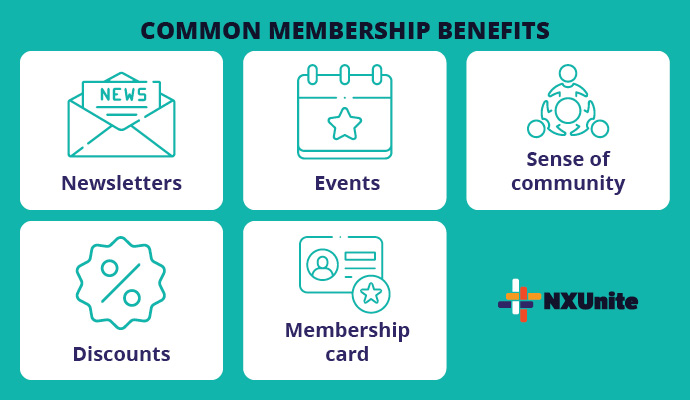
This image shows some of the common membership benefits nonprofits offer.

Here are some benefits that are frequently offered in membership programs:

  • Members-only newsletters. Send your members exclusive newsletters with behind-the-scenes information not available to others. You can even give sneak peaks of future events. For instance, a botanical garden could tease images of their evening lights display.
  • Event perks. These perks can be early access to ticket purchases or early event registration. You can also offer event-specific perks, like free raffle tickets or extended bidding time for an auction. Make sure your ticketing and registration system is powerful, organized, and allows you to offer early and regular registration.
  • Community. Aside from offering event perks, you can also host member-exclusive events or meetings. For example, an art museum could host an event showing highly-anticipated artwork that the general public won’t be able to see.
  • Discounts. Organizations like aquariums that require ticket purchases often offer their members free or highly discounted tickets. Your organization could also offer a discount on merchandise, event tickets, or other services.
  • Membership cards. Giving your members a physical or digital membership card can help foster a sense of community and inclusivity. Make sure the graphic on the card is designed well so that members will feel proud displaying it.

Whether you are a cultural organization or a nonprofit, a membership program can be a great way to generate revenue and involvement. Offering participants member benefits makes the relationship mutually beneficial, making it much more likely that people will want to take part in your program. Make sure you have a powerful membership management software to guarantee success!

Additional Resources

Nonprofit Catalog – Read up on more nonprofit essentials by exploring our Nonprofit Catalog.

Donor Segmentation – Donors interact with your organization in different ways. Learn more about how to appeal to your different donor segments.

Nonprofit Marketing – Looking for other ways to promote your organization? Check out this guide.

A person stands at a desk looking at a computer. Text: "Boosting Virtual Member Engagement: The Definitive Guide"

Boosting Virtual Member Engagement: The Definitive Guide

Member engagement is a driving force in growing your association. Fonteva’s guide to member engagement defines this term as “the ongoing outreach and interactions between associations and their members to keep constituents informed, educated, and motivated to continue their memberships.” With an engaged membership base, your organization will see increased retention, a stronger community, and even increased non-dues revenue.

When planning for your association’s future, it’s crucial to consider how you will keep current members engaged while attracting new ones. Improving member engagement will require you to explore your association’s strengths and weaknesses as well as your members’ needs and preferences. To get started, you’ll need to employ the following strategies:

  1. Set goals and choose engagement strategies.
  2. Understand and appeal to members.
  3. Prioritize community building.

In this guide, we’ll break down each of these tactics and how they will put you on the path toward deeper virtual engagement. Let’s get started! 

1. Set goals and choose engagement metrics.

Outlining the goals you’d like to achieve must be the first step you take toward increased engagement. The goals your organization chooses will dictate which initiatives you focus on, how resources are allocated, and which metrics you’ll need to track in order to measure success.

To get started, look at your association’s past performance. You might reference member surveys to understand what areas could use improvement, developing goals meant to target those weaknesses. Kellen’s guide to strategic planning for associations suggests you set “ SMART” goals, or goals that are specific, measurable, achievable, relevant, and time-bound.

Let’s say you want to boost your association’s social media presence. One of your goals could be to increase your LinkedIn follower count from 500 to 1,000 within the next year. Because this goal uses a specific number and timeframe, is realistic, and is relevant to your objective, it qualifies as a SMART goal.

Once you’ve settled on a few engagement goals for your association, it’s important to start tracking metrics related to those goals so you can accurately measure your progress. Here are some common key performance indicators (KPIs) that can help you track improvements in virtual member engagement:

  • Social media metrics: Social media provides a treasure trove of useful data about users and how they interact with your page. You can track your follower count, likes, comments, shares, click-through rates, and more (depending on your goals). To narrow down which metrics you’ll track, remind yourself of your goals and develop KPIs that directly apply to those goals.
  • Virtual event KPIs: If your association holds virtual or hybrid events, make sure to measure the engagement of virtual attendees (just like you would for in-person attendees). You can measure factors like registrations, actual attendance, returning and new attendees, and participation time.
  • Email marketing engagement: Emails likely play a big role in how your association attracts new members and connects with existing ones to keep them in the loop. You can track how engaged members are in your announcements, newsletters, fundraising prompts, or other campaigns by measuring metrics like open rates, click-throughs, conversions, and unsubscribes.

Many of these metrics can be tracked using an association management tool to create custom reports to visualize your organization’s performance. These reports provide a much more accurate, easy-to-understand way to analyze association data.

2. Understand and appeal to members.

After deciding on your association’s core engagement goals and identifying how you’ll measure progress, you’ll need to start implementing strategies that improve engagement opportunities for members.

If your organization is seeing low engagement rates across the board, your current offerings may not align with what members are looking for. To make the switch to discussing topics and holding events your members will be excited about, you’ll need to learn more about their interests.

Here are some of the strategies you can use to understand your members and adjust association activities to meet their needs:

  • Send out surveys. Surveys are a great way to see inside your members’ minds and hear directly from them what they expect from your organization. There are many kinds of surveys you can send, depending on what you want to learn from members. You might send more general surveys asking about their interests, or narrow the subject by asking how your virtual engagement strategies could be better. Another popular way to get member feedback is by sending post-event surveys (ideally, there should be separate surveys for in-person and virtual attendees).
  • Segment members. Create groups of members based on shared characteristics like their interests, tendencies, or preferences. For example, you might create a subset of members who take advantage of almost all of your continued learning opportunities and further segment these members by their communication preferences. Then, you can direct communications about the opportunities and subjects they are interested in to those segments as appropriate.
  • Set up a variety of engagement opportunities. Because your members each have different preferences and goals, make sure to offer various engagement opportunities to address their unique needs. Options for virtual engagement can include virtual events, meetings, learning opportunities, and discussion forums, all providing a different way to connect and build a community. For instance, members who want to expand their network and form relationships outside of association events and meetings may use your membership directory most often.
  • Work with an association management company (AMC). An AMC will offer the expertise you need to effectively engage members in various ways. These service firms can send surveys, create segmentation strategies, and create many engagement opportunities (such as virtual events and online educational resources) for you. This way, you can rest assured that the strategy and execution of your operations are at the highest level.

Taking an approach that focuses primarily on meeting individuals’ needs rather than creating a blanket solution will make all members feel included and catered to. Over time, this careful consideration will help build more positive member experiences.

3. Prioritize community building.

Additional engagement opportunities like fun events or fundraisers can help add value to the membership. These activities strengthen the bonds between members in your community, leading to increased renewals and member retention rates. While you may think of these events as being limited to in-person annual dinners, there are virtual and hybrid options you can extend to remote members as well (like a quarterly virtual happy hour). 

Fundraisers are a great way to unite your members for a common cause, whether you are fundraising for your association or on behalf of a charitable organization. To get members more engaged in the fundraising process, you can put together a member-led fundraising committee. Give this committee specific responsibilities like developing fundraising ideas, planning fundraisers, and executing fundraising events.

After your event or fundraiser wraps up, always remember to thank those who attended or donated. These thank yous will keep members coming back to your events or donating in the future. Keep in mind that the time period following a successful event or fundraiser can be a good opportunity to send renewal reminders, if applicable.

Virtual member engagement goes beyond encouraging connections between individual members and your association. It also motivates members to connect with one another, building a web of professional relationships that they can leverage to advance their careers, further their education, and secure exciting new opportunities. To achieve this level of engagement and give members the experiences they are looking for, be sure to select a membership management platform that will make implementing new strategies and measuring your progress simple.

Misconceptions About Nonprofit Financial Transparency

4 Misconceptions About Nonprofit Financial Transparency

By Darryl Gecelter

Financial transparency is a key part of your nonprofit’s risk management strategy and its ability to create meaningful connections with supporters. However, many leaders resist this shift due to outdated fears that high visibility creates vulnerability. 

In this guide, we’ll outline five of the most common misconceptions about nonprofit financial transparency and provide insights into its realities that help you improve your communication strategy.

Myth 1: Achieving nonprofit financial transparency means making every receipt public.

Financial transparency seems overwhelming if you believe it requires your organization to share every line item in your budget and spending. In reality, stakeholders rarely have the time or inclination to parse through a raw general ledger. 

Maintain transparency without overwhelming stakeholders by:

  • Creating a categorized expense summary to show broad allocations rather than individual line items, satisfying donor curiosity without including too much information. Grouping costs into clear buckets like program delivery, fundraising, and general operations provides a clean, immediate snapshot.
  • Sharing high-level annual budgets on your website so community members can see your overarching vision for the fiscal year. This practice enables donors to understand your strategic priorities and how future revenue directly funds community initiatives.
  • Utilizing secure banking platforms that allow internal teams to track details accurately while easily exporting clean, simplified reports for public consumption. A modern financial tech stack ensures that while your internal records remain exhaustive, external documents stay concise and polished.

Consider implementing a dedicated financial FAQ page alongside your annual reports to preemptively address common financial inquiries. This might include questions like “How much revenue is dedicated to overhead costs?” or “What percent of revenue came from fiscal sponsors versus individual donations?”

Myth 2: Only large institutions need formal fiscal reporting.

Emerging charities frequently assume their grassroots status excuses them from corporate-level scrutiny. However, building robust accounting habits early signals maturity and increases your likelihood of securing grants and major donations that provide sustainable funding

To get started with financial reporting as a smaller nonprofit, send simple quarterly updates via email newsletter to keep stakeholders in the loop on your funding progress. For example, a local youth literacy program might share a one-page graphic showing how recent microdonations funded a textbook drive.

Build scalable data habits early with the right tech infrastructure, so your reporting processes naturally grow alongside your annual revenue. Crowded suggests using a unified financial platform built for nonprofits so you can maintain visibility and automate compliance as you grow. These tools enable complete oversight of your finances and simple donation processing, so you’ll be able to streamline your fiscal reporting.

Myth 3: Donors only care about emotional impact stories.

Heartfelt testimonials are undeniably effective at capturing initial interest, but relying solely on emotion is a risky strategy for long-term retention. Donors want to see that your organization has a thoughtful strategy for stewarding their funds and sustaining its mission. UpMetrics’ guide to impact reporting suggests blending qualitative and quantitative data in your appeal to strengthen your case for support.

To merge your storytelling with financial data, employ these techniques:

  • Pair statistics with beneficiary stories to create a holistic view of how operational funding enables on-the-ground impact. For example, a local food bank might share that it provided 10,000 pounds of food to community members over the past year. Then, they might share a video testimonial with a beneficiary who can speak to how their family was impacted by the bank’s services.
  • Create visual financial infographics that translate dense spreadsheets into easily digestible charts. This is particularly helpful for board meetings where members need to understand big-picture insights at a glance.
  • Address donor stewardship proactively by sending dedicated follow-ups that explain how a supporter’s specific contribution was allocated within the broader budget. This reinforces the donor’s decision to give by making the impact of their contribution feel more tangible.

Send specialized impact reports to lapsed donors that specifically highlight updates to your operational efficiency to re-engage them. Demonstrating an evolved commitment to financial stewardship reassures hesitant supporters that their future gifts will be handled with care.

Myth 4: Sharing data invites micromanagement.

Nonprofit financial transparency can feel like inviting the public to judge every minor expense, which can make nonprofit leaders hesitate to open the books. You’ll find, however, that just the opposite is true; when your nonprofit refuses to share its financial data, that is what breeds speculation and suspicion. 

Proactively sharing your data allows you to guide the conversation by:

  • Defining clear boundaries for public data upfront, ensuring your team knows exactly which metrics are for internal review versus external publication. An established framework prevents accidental oversharing while ensuring compliance with standard reporting expectations.
  • Hosting annual review meetings where community members can ask questions in a structured environment. By directing inquiries into a formal town hall setting, you’ll ensure day-to-day operations remain uninterrupted by ad hoc donor questions.
  • Focusing on the overarching strategy when presenting data, steering conversations toward the big picture rather than administrative minutiae. If a stakeholder questions a specific marketing expense during a board meeting, you can put that question in the “parking lot,” which means you’ll continue discussing the overarching campaign in the moment, but you’ll return to any detail-specific questions at the end of the meeting.

A unified communication policy ensures that every staff member delivers consistent answers regarding financial practices. This internal cohesion projects organizational competence, which deters attempts to pick apart daily operations.

Sustain trust through balanced reporting.

By finding the right balance between necessary privacy and public accountability, you secure the trust needed to support and expand your mission for years to come. Make it a habit to audit your public-facing financial materials annually to ensure they remain accessible, visually engaging, and aligned with your evolving strategic goals.