Top Corporate Sponsorship Search Tools & Databases to Know
In the modern philanthropic landscape, the competition for funding is more intense than ever. While individual giving remains the backbone of most charitable organizations, sponsorships represent a massive, often untapped opportunity for growth. However, the days of sending generic cold emails to local bank managers and hoping for a check are gone. Today, successful nonprofit partnerships are built on data, alignment, and strategic outreach. And the right corporate sponsorship search tools are here to help!
In this guide, we’ll explore the top platforms every fundraising professional should know. These include:
- Double the Donation (the gold standard for corporate giving)
- Instrumentl (the institutional powerhouse)
- LinkedIn (the ultimate relationship and networking tool)
To secure a high-value corporate sponsor, you need to know who is giving, how much they are giving, and, most importantly, what they expect in return. By leveraging specialized tools and databases, nonprofits can move from a “shotgun” strategy to a “sniper” approach, identifying the companies most likely to say yes.
Let’s dive in with our first recommendation!
1) Double the Donation: The Gold Standard for Corporate Giving
When it comes to understanding corporate philanthropy, Double the Donation stands in a league of its own. While many know it primarily as the leading platform for employee matching gifts, its continuously growing database serves as the most comprehensive and targeted resource for identifying corporate sponsorship opportunities today.
Platform Overview
Double the Donation hosts the industry’s most extensive source of corporate giving programs. With information on over 24,000 companies, the Double the Donation database tracks everything from matching gift programs and volunteer grant initiatives to specific corporate sponsorship opportunities.
Unlike general business databases, Double the Donation is built specifically for the nonprofit sector. This means the data is filtered through the lens of social impact. It doesn’t just tell you that a corporation is profitable; it tells you exactly how that company chooses to distribute its wealth back into the community (such as through grants, in-kind donations, workplace giving programs, and beyond).
Using Double the Donation as a Sponsorship Search Tool
While many organizations use Double the Donation to recapture low-hanging fruit via matching gifts, savvy development directors are also leveraging it as a strategic prospecting tool for major sponsorships.
Here’s how it works:
- Targeted Corporate DNA Mapping: Double the Donation provides a granular view of a company’s philanthropic offerings. If a business has a robust matching gift program, it is an objective indicator that it values employee engagement and community support. This makes it a prime candidate for a deeper sponsorship relationship.
- Identifying Open Applications: By using the database to see which companies offer existing sponsorship programs (often with open applications available online), you can easily identify top prospects to engage. From large-scale event sponsorships to generous corporate grants, Double the Donation even provides direct links to application forms to further streamline the process.
- The “Inside Track” via Existing Donors: One of the most effective ways to use Double the Donation for sponsorship is by looking at your current supporter base. The fundraising platform (when integrated with your donation forms, volunteer management systems, and more) identifies where your donors and volunteers work. If you notice that a number of loyal supporters all work for a specific tech firm, you now have the hard data to approach that firm’s CSR department. You can say, “50 of your employees are already invested in our mission; let’s formalize this through a corporate sponsorship.” This turns a cold lead into a warm, data-backed proposal.
- Comprehensive CSR Profiles: The database includes specific details on corporate giving guidelines. This allows nonprofits to see whether a company’s philanthropic mission aligns with their own (e.g., environmental focus, education, or healthcare) and what types of giving they offer (in-kind, grants, sponsorships, etc.) before they ever send an introductory email.
How Nonprofits Are Encouraged to Use It
Nonprofits should view Double the Donation not just as a tool for revenue recovery, but as a central hub for corporate intelligence. To get the most out of it, we recommend:
- Integrate With Your Donation Forms & CRM. Ensure Double the Donation is integrated with your full fundraising tech stack, including your donation forms and donor management system. This allows the tool to collect and tag employment information as supporters engage with your organization, creating a hot list of potential corporate sponsors based on existing affinity.
- Leverage the Pre-Made Reports. Use the data found in the platform to craft your sponsorship pitch. For example, Double the Donation’s “Leading Companies” report automatically compiles a list of top employers selected by your donors and volunteers. When you can show a company exactly how many of their employees are engaged with your cause, your sponsorship proposal moves to the top of the pile.
- Conduct Regular Database Audits. Periodically dive into the database to research local businesses and national companies alike. Look for those that have recently expanded their giving programs, as this often signals a shift in their marketing or CSR strategy that may include new sponsorship slots.
If you’re interested in exploring Double the Donation’s corporate sponsorship search tools and more, request a personalized demo here to get started.
2) Instrumentl: The Institutional Funding Powerhouse
While Double the Donation excels at the intersection of individual donors and their employers, Instrumentl is a premier tool for organizations looking to bridge the gap between corporate grants and corporate sponsorships.
Platform Overview
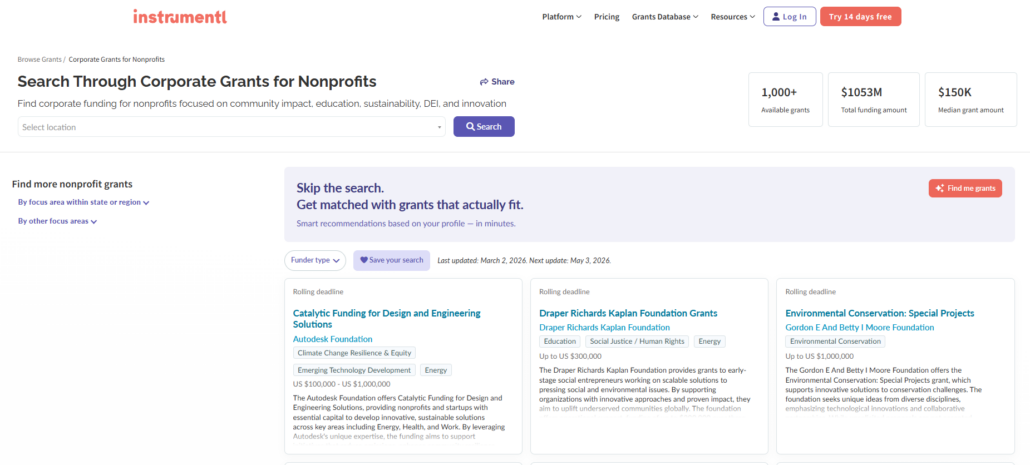
Instrumentl is an all-in-one institutional fundraising platform that combines effective grant prospecting, tracking, and management. It is designed to help nonprofits find funders that match their specific projects, locations, and missions.
What sets Instrumentl apart is its ability to aggregate data from 990 forms, foundation websites, and corporate giving pages into a single, searchable interface.
Using Instrumentl as a Sponsorship Search Tool
Many corporate sponsorships are funneled through a company’s private foundation or its community benefit department. Instrumentl allows you to find these opportunities with precision.
Here’s how it works:
- Mission-Based Matching: Instrumentl uses an algorithm to match your nonprofit’s “Project Profile” with funders who have a history of supporting similar work. If you’re seeking a sponsor for a STEM education program, Instrumentl will surface corporations that have specifically earmarked funds for such initiatives.
- 990 Analysis for Sponsorship Capacity: For companies that sponsor nonprofits through corporate foundations, Instrumentl provides a simplified view of their IRS Form 990s. This is crucial for sponsorship research because it shows you exactly who they’ve given to in the past and even how much they gave. If you see a company recently sponsored a similar event at the $10,000 level, you know exactly what to ask for in your proposal.
- Geography-Specific Filtering: If your nonprofit operates at the local level, Instrumentl allows you to filter for businesses that focus their giving on specific states or ZIP codes. This prevents you from wasting time on national corporations that only sponsor events in their headquarters’ city.
How Nonprofits Are Encouraged to Use It
Instrumentl is best used as a pipeline management tool. For this reason, nonprofits leveraging this platform are encouraged to:
- Set Up Active Searches. Create specific projects within the platform for your different sponsorship needs (e.g., “Annual Gala” or “Summer Youth Camp”). Instrumentl will then automate alerts when a new corporate funder matching that project’s criteria is found.
- Evaluate Funder Reliability. Use the “Funder Openness” metrics to see if a corporation accepts unsolicited proposals. Many sponsorships accept proposals by invitation only, and Instrumentl helps you distinguish between a closed door and a wide-open opportunity.
- Track Deadlines. Corporate sponsorship cycles often operate on a different calendar than the fiscal year. For this reason, Instrumentl helps you track these deadlines, ensuring you never miss a sponsorship application due date.
If you’re interested in exploring Instrumentl’s corporate sponsorship search tools and more, sign up here to get a 14-day free trial.
3) LinkedIn: The Ultimate Relationship & Networking Tool
While the previous tools provide the “what” and the “how much,” LinkedIn provides the “who.”
Corporate sponsorships are, at their core, relationships between people. LinkedIn is one of the most powerful tools available for identifying and reaching the actual decision-makers within a corporation.
Platform Overview
LinkedIn is a professional networking site with over 900 million active members. For a nonprofit, this site serves as a live, self-updating database of corporate hierarchies. It allows you to move past the “info@company.com” email address and find the specific individuals responsible for CSR, marketing, and community relations.
Using LinkedIn as a Sponsorship Search Tool
LinkedIn is the perfect tool for the “discovery” and “outreach” phases of a corporate sponsorship search, making it easy to connect with the best prospects.
Here’s how it works:
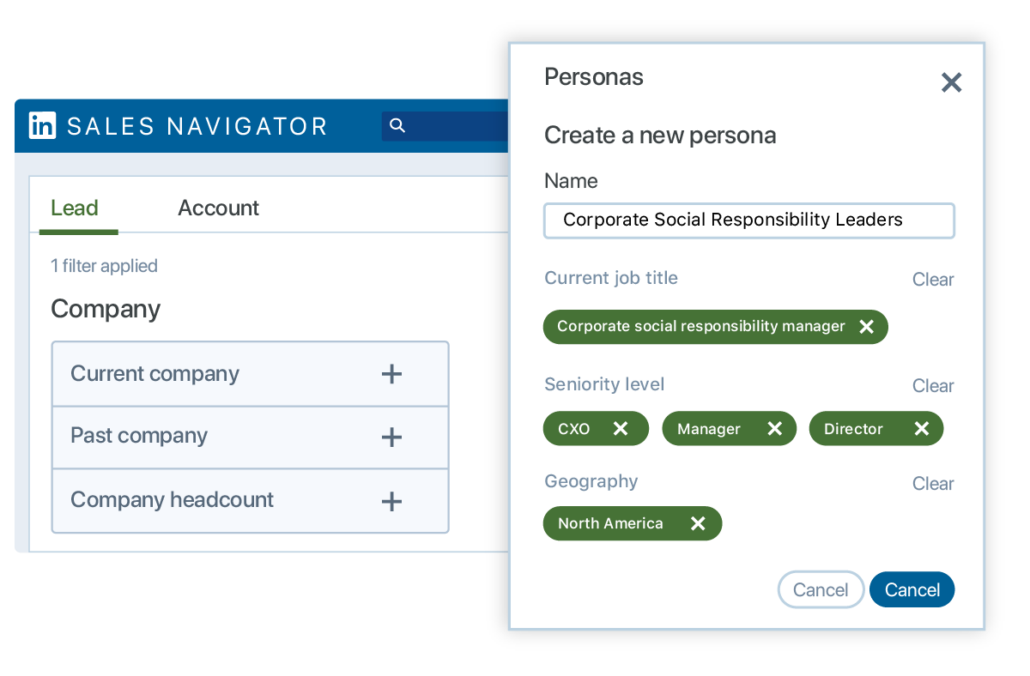
- Identifying the Right Decision-Maker: Depending on the company’s size, sponsorship decisions may be made by the Head of CSR, the Marketing Director, or even the CEO. LinkedIn’s filters allow you to search by job title and company to find the exact person who holds the checkbook.
- Making the Most of Mutual Connections: The most effective way to secure a sponsorship is through a warm introduction. LinkedIn shows you if any of your board members, volunteers, or current donors are connected to the decision-makers at your target company. A 2nd-degree connection can be the difference between an ignored email and a signed contract!
- Researching Corporate Values: Companies often post about their recent community involvements on LinkedIn. By following a company’s “Life” page or subscribing to its executives’ posts, you can gain valuable insights into what they currently care about. If a CEO is posting about their commitment to sustainability, you can tailor your sponsorship pitch to highlight your organization’s green initiatives.
- Leveraging Sales Navigator for Nonprofits: For larger organizations, LinkedIn Sales Navigator (available at a lower cost for nonprofits) offers advanced search features. This allows you to save lists of corporate leads and receive alerts when they change jobs or post relevant content.
How Nonprofits Are Encouraged to Use It
LinkedIn should be used as a social listening and active connection tool. For this reason, nonprofits seeking sponsorships are encouraged to:
- Optimize Their Organization’s Page. Before you reach out to a corporate executive, ensure your nonprofit’s LinkedIn page is professional, up to date, and showcases the impact of your current corporate partners.
- Perform a Board Mapping Exercise. Regularly sit down with your board of directors and have them scroll through their LinkedIn connections. When you find them, ask the board member to facilitate a warm introduction rather than making a cold call.
- Implement Personalized Outreach. When reaching out on LinkedIn, never send a generic “InMail.” Rather, reference a specific project the company recently completed or a post the executive shared. Show that you have done your homework and demonstrate how the partnership would tie into their corporate giving motivations.
If you’re interested in exploring LinkedIn’s corporate sponsorship search tools and more, check out their nonprofit discount here.
Strategic Synthesis: How to Combine These Tools for Maximum ROI
While each of these sponsorship search tools is powerful on its own, the most successful nonprofits use them in concert to create a seamless partner acquisition strategy.
Here’s what a master workflow can look like:
- Strategic Discovery With Double the Donation: Start by reviewing your current donor list in Double the Donation. You discover that you have a high concentration of donors who work for “Global Tech Corp.” You then use the sponsorships database to see that Global Tech Corp has a massive social impact budget and an open application online for event sponsorship. You have now identified a Hot Lead.
- Smart Vetting Through Instrumentl: You then take “Global Tech Corp” over to Instrumentl. You look up their foundation’s 990 data. You see that they have previously sponsored an arts festival in your city for $25,000. You also see that their grant cycle for the upcoming year opens in three months. You now know both the price point and the timeline.
- Targeted Outreach Via LinkedIn: Finally, you go to LinkedIn. You search for “Global Tech Corp” and filter by “People” and “Community Relations.” You locate the Director of Social Impact, and discover that your Board Treasurer is a 1st-degree connection with this individual. You ask your Treasurer to send a brief introductory message. You now have the relationship that will make your sponsorship pitch stand out!
By following this data-driven path, your chances of securing the sponsorship increase exponentially. You aren’t just guessing; you are using the most robust tools available to build a case that is impossible to ignore.
Strategic Considerations for the Modern Fundraiser
As you integrate these tools into your sponsorship-seeking workflow, keep in mind that the nature of corporate partnerships is shifting. Many companies are moving away from philanthropy (or giving money away) and toward shared value (or investments that benefit both the community and the business).
These are a few things you’ll want to keep in mind.
The Power of Targeted Data
Double the Donation is highlighted as the most robust tool in this list because it provides the most targeted data for this “shared value” model. By identifying which companies have employee-led giving programs, you are identifying companies that have already decided to let their values be driven by their people. This is the ultimate “targeted info.”
A company that matches employee gifts is a company that listens to its employees, and if your nonprofit has those employees as donors, you have a built-in advocacy group within the corporation.
Moving Beyond the Logo on a T-Shirt
In the past, sponsorship search databases were used just to find someone to pay for a banner at a 5K race. Today, these tools should be used to find long-term partners whose missions closely align with your own.
The shift from transactional to transformational partnerships is driven by a change in how businesses view their social impact. More and more, corporate leaders are under pressure from both consumers and employees to prove that their commitment to a cause is more than just a marketing gimmick. They want to show that they are actively helping to solve a problem.
Prioritizing Regular Data Updates
The corporate world moves fast. Mergers, acquisitions, and leadership changes happen daily. This is why using a live (and regularly updated) database like Double the Donation is so critical. Static lists of “Top Corporate Givers” from three years ago are largely useless. Rather, you need tools that reflect the current market reality.
Conclusion
Securing corporate sponsorships is both an art and a science. The “art” lies in the storytelling and the relationship-building, or the ability to convey your mission in a way that resonates with a corporate executive’s vision. But the “science” lies in the technology you use to find those executives in the first place.
By equipping your development team with the right tools, you can gain easy access to companies ready and eager to support organizations like yours.
In an era where every dollar must be fought for, you cannot afford to work with incomplete information. These top-recommended platforms provide the transparency and the insights needed to turn corporate sponsorship from a game of chance into a predictable, scalable revenue stream for your nonprofit.
Start with the data, build the relationships, and watch your organization’s impact grow.