Tag Archive for: nonprofit financial management

The title of the post: “Managing Risk at Nonprofits: What Boards Need to Know.”

Managing Risk at Nonprofits: What Boards Need to Know

A nonprofit board is a governing body responsible for strategic decisions and oversight at a charitable organization. One of the best-known duties of a board is to appoint a nonprofit executive director or CEO who will then keep the board informed about day-to-day operations and vital information needed to make decisions. 

Another key responsibility of nonprofit board members is to manage organizational risk. Nonprofits face some of the same risks that for-profit businesses do, but there are also some risks unique to tax-exempt organizations, and each nonprofit will have its own unique risk profile based on operations, revenue, location, and other factors. Risks are inescapable, but unmonitored risks can quickly go from bad to worse if nothing has been done to prepare for potential issues. 

In this guide, we’ll cover what board members should know about managing risk at the nonprofit they serve. Let’s dive in!

Who is responsible for nonprofit risk management?

For risk management to be effective, all staff and board members at the organization need to be involved. The proper policies apply to everyone, from staff members remembering to lock the office door at the end of the day to the financial team properly recognizing revenue to a volunteer properly reporting a safety incident. 

To ensure all stakeholders (employees, board members, volunteers, donors, etc.) are equipped to minimize risk, effective risk management begins with crafting policies and procedures that prepare for potential situations. Let’s take a look at each stakeholder’s role in risk management:

  • As a board member, you will supervise and direct the creation and implementation of risk management policies and procedures.
  • The nonprofit’s leadership team will create policies and procedures, then execute them.
  • Your nonprofit may bring in external financial professionals to consult on the design of your risk management process, since many potential nonprofit risks impact your finances.
  • Staff members implement the policies and procedures and ensure that the guidance is shared with other stakeholders (such as volunteers) who might be affected by the risk management policies.

While you may not have frequent interactions with all of the nonprofit’s staff as a board member, setting a culture of policy compliance and risk minimization begins with the board. By prioritizing risk management and making policies clear and achievable, you set the tone for everyone else’s efforts.

What does proactive risk management look like?

Policies and procedures are the first step in risk management, but they don’t fix everything by themselves. We’ll cover policy examples in more detail below, as well as two other ideas to evaluate as a board member.

Establish policies and procedures

As a nonprofit grows larger and more complex, there will likely be more and more policies that need to be established to account for new incidents that may arise. But every nonprofit board should consider the following areas of risk and corresponding policies and procedures:

  • Financial management: Internal controls, which we’ll discuss in more depth in another section, fall into this category, but outlining how money is handled (where any cash is stored, who signs off on big purchases) and spent within the organization is crucial. A few financial policies to consider specifically are:
    • Gift acceptance so team members understand what monetary and in-kind contributions they can and can’t accept
    • Staff compensation so that all employees (especially leaders) are paid fairly but not excessively in the eyes of the IRS
    • Expense reimbursement so staff and volunteers know when they’re eligible to be paid back after spending their own money on your nonprofit’s behalf
  • Data privacy: Outline clear guidelines for the collection, use, and storage of personal data. This is particularly delicate as nonprofits receive financial information from donors. A data breach could expose sensitive details and compromise supporters’ trust in your organization.
  • Workplace harassment: Even if the nonprofit is relatively small, implementing workplace harassment awareness and prevention training is crucial. Boundaries can sometimes blur in smaller work environments, and communicating ethical and legal standards can mitigate harm to employees and stakeholders.
  • Background checks: Particularly if your organization serves vulnerable populations, implement background checks for anyone who works with those groups. For example, you’ll want to run a check for a volunteer who helps in the nursery during a service at a faith-based organization or anyone who handles your nonprofit’s money.
  • Conflicts of interest: This policy often applies to board member activities like voting. Your guidelines should require board members to disclose any potential conflicts of interest and outline next steps (such as that member abstaining from a certain vote or the whole board re-evaluating a decision).

This is not a definitive list of potential risk areas and mitigating guidelines that your nonprofit may face. Consulting with a nonprofit financial advisor can illuminate risks unique to your organization and provide guidance for how to begin preventative measures.

Diversify your nonprofit’s team

For both the board and staff, if everyone has the same set of skills, you’re exposing your organization to additional risks, because you’re not accounting for the diverse range of abilities that are required to successfully operate a nonprofit. Part of this is also staffing your nonprofit sufficiently. When employees are overwhelmed with tasks, things are more likely to fall through the cracks, especially tasks that employees don’t have the skills for.

When you’re recruiting new board members, keep in mind what skills and experience might be lacking on your board, but would help steer the nonprofit. A few skills or occupations that might be useful to have include a lawyer, a financial professional, and a development professional. 

Additionally, for your nonprofit executive team, you’ll want to make sure you have the right person in crucial positions, like a Chief Financial Officer role. Jitasa recommends working with a fractional CFO if your nonprofit doesn’t have the resources to hire someone full-time for this position. 

Across the organization, it’s a good idea to have a clear delegation of duties based on areas of expertise and clear training protocols for when team members take on new duties. Having owners of tasks holds team members accountable and increases the likelihood that they will be completed to the highest standard of quality.

Implement internal controls

Internal controls are policies and procedures that your nonprofit implements on top of legal and financial standards. Controls safeguard against intentional and unintentional fraud, like having two employees sign off on cash deposits, which can catch any counting errors. 

Some internal controls will affect day-to-day activities, like storing any cash in a locked drawer or safe, and some might occur less frequently, like conducting an audit or determining what percentage of reserve funds should be invested. As a board member, this is another area to review with financial consultants to make sure proper controls are in place.

How should you mitigate and respond to risks? 

A lot of the battle when it comes to risk management is planning for the worst, ahead of time. This includes being on the same page with the executive team about what board members’ roles are when it comes to a risky situation actually occurring. 

Outline who should be alerted to risks and within what time frame. Triaging the risk according to pre-determined categories, like the severity of consequences, can inform communication procedures. 

Once you’ve been informed of the risk, as a board member, it’s your responsibility to ensure that policies are followed, and you support the nonprofit executive team if complications arise. 


Preparing for the worst might be uncomfortable, but implementing risk management is necessary for any organization’s health and sustainability. As a board member, your risk management leadership is crucial to ensuring that your nonprofit’s mission is carried out no matter what circumstances come its way.
The title of the post: “How to Prepare for a Nonprofit Audit: Essential Steps.”

How to Prepare for a Nonprofit Audit: 4 Essential Steps

If your nonprofit is considering conducting an audit, you might feel intimidated or worried, especially if it’s your first time. However, audits are a crucial part of effectively managing your organization’s finances, ensuring proper governance, and maintaining transparency with stakeholders. And once you understand the process, it isn’t nearly as scary as it may seem!

Most nonprofits hire external professionals to conduct audits, but that doesn’t mean your team should contact the first auditor you find and leave everything in their hands. Rather, proper internal preparation helps ensure your audit is accurate, timely, and useful for shaping your organization’s financial practices going forward.

In this guide, we’ll walk through four steps your nonprofit should take to get ready for its audit and lay the foundation for receiving thorough, actionable results. Let’s dive in!

1. Decide What Type of Audit You Need to Conduct

While the term “audit” is most often used in financial contexts, not every nonprofit audit focuses on finances. Different types of audits serve different purposes, and the right one for your nonprofit depends on your unique needs, goals, and priorities.

According to Jitasa’s nonprofit audit guide, the most common audit categories are as follows:

  • Independent financial audit. This type of audit occurs when a third-party auditor reviews your financial data, documentation, policies, and procedures to provide an expert, objective perspective on your nonprofit’s health and compliance.
  • Internal financial audit. This audit is similar to the independent financial type, except your nonprofit’s employees are the ones reviewing its financial information. Although these audits can’t be completely objective, they give your team a chance to think critically about your organization’s financial situation.
  • IRS financial audit. The IRS doesn’t audit tax-exempt organizations often, but if your nonprofit fails to file its annual tax return or a discrepancy is discovered, a government agent may come calling.
  • Compliance audit. These audits assess your organization’s adherence to internal (i.e., bylaws and policies) and external guidelines (i.e., federal, state, and local government regulations). Financial compliance is part of this audit, but it also touches other areas of your organization, such as fundraising and administrative compliance.
  • Operational audit. This category of audits involves analyzing processes and systems to identify ways to improve efficiency and effectiveness. They can be general or focused on one area of your operations like technology or human resources.

For the purposes of this article, we’ll focus primarily on independent financial audits since they’re the most common type of nonprofit audit. They’re also the most likely type of audit to be required for your organization, whether because of a stipulation in your bylaws, a federal or state government regulation, or a request from the funder of a grant you’re pursuing.

2. Lay out Your Auditing Timeline

The entire independent financial audit process takes several months to complete. If you have a deadline to submit your audit report to a grantmaker or government agency, note that date and work backward to figure out when you need to begin, building in some wiggle room to ensure you finish in time.

Here is a quick breakdown of the phases of the audit process and how long each one typically takes:

  • Selecting an auditor: 4-12 weeks
  • Preparing for the audit: 2-4 weeks
  • Conducting the audit: 2-4 weeks
  • Implementing audit recommendations: No specific timeline, but the sooner you can start, the better!

If your nonprofit doesn’t have an external deadline for your audit, try to conduct it and begin implementing the recommendations before completing your annual tax return. This way, you can let the IRS know that you’re actively improving your processes, and your team won’t have to work on two major financial projects at the same time.

The Form 990 filing deadline is the 15th day of the fifth month after the end of your nonprofit’s fiscal year (May 15 for organizations whose fiscal year follows the calendar year). You can extend the due date by up to six months if needed to conduct your audit—you’ll just have to file Form 8868 and get approval from the IRS to make the extension official.

3. Select a Nonprofit Auditor

Choosing your auditor typically takes longer than any other step in the independent auditing process. It’s important to select an individual or firm that can meet your needs and goals while working within your budget and timeline. 

Here is a basic overview of how to find the right auditor for your nonprofit:

  • Conduct online research, making sure to read reviews from each candidate’s past clients and noting their pricing structure. 
  • Ask for recommendations from other nonprofits in your network that have undergone financial audits and from your organization’s accountant (who typically won’t conduct your audit to avoid a conflict of interest, but likely knows of auditors who can).
  • Issue a Request for Proposals (RFP), which Cornershop Creative describes as “a formal document that outlines the requirements, specifications, and criteria of a project or service [and] serves as an invitation for qualified vendors or partners to submit bids.”
  • Meet with your top candidates after reviewing their proposals to compare costs, timelines, and scope of work so you can make an informed final decision and send your chosen auditor an accurate contract.

Just like with hiring financial team members for your organization, look for auditors who specialize in working with nonprofits. When searching online, use keywords like “nonprofit auditing firms near me” or “nonprofit auditors in [city name]” to narrow your results. Additionally, make sure their past clients include nonprofits of approximately the same size as yours to ensure they’re familiar with similar financial situations.

4. Organize Your Financial Records & Reports

After signing your contract and scheduling your audit, your auditor will send over a Provided by Client (PBC) list. This list details all of the documents they’ll need to complete their review, which can range from your fiscal policy handbook to financial statements to board meeting minutes. Compile these resources in a digital folder that you can share with your auditor for easy access.

However, pulling together everything on the PBC list is only part of the audit prep equation. You also have to clean up your accounting system—not only to help your auditor find the information they need in it, but also to demonstrate that you’re practicing good financial data hygiene, which the auditor will be looking for as they assess your procedures.

Before your audit, make sure to:

  • Reconcile all bank and investment accounts
  • Ensure restricted funds and assets are properly tracked
  • Resolve any uncategorized or uncleared transactions
  • Deposit any undeposited funds
  • Review receivables and payables
  • Identify and fix coding errors (e.g., duplicated or inconsistent entries)

If you need help with these tasks, your bookkeeper or accountant can help you identify and resolve any issues in your accounting system before the audit begins and pull any reports you might still need for your PBC folder.


Even if you prepare thoroughly for your audit, your report might not be perfect, which is completely fine! Remember that your auditor isn’t just there to check boxes. They can be a valuable partner in helping your organization develop sustainable practices for long-term financial success. 

When you get your report, take some time to review the recommendations with your team and determine the best ways to incorporate them into your financial management activities. Then, hopefully, your next audit can go even more smoothly!

The title of the article, “Beginner's Guide to Understanding a Nonprofit Balance Sheet.”

Beginner’s Guide to Understanding a Nonprofit Balance Sheet

While the process can be tedious, compiling nonprofit financial statements allows your organization to evaluate its financial standing and stay accountable to stakeholders. These documents help you use resources effectively to fulfill your nonprofit’s mission.

One of the main financial statements nonprofits develop is a nonprofit balance sheet. To get you up to speed, we’ll review the basics of this report, why it’s important, and how to interpret it so your organization can maximize this data.

What is a nonprofit balance sheet?

A nonprofit balance sheet provides details about your organization’s financial health as of a specific date. Also called a Statement of Financial Position, this report summarizes your nonprofit’s liquidity and financial flexibility through its assets and liabilities.

Why is it important for nonprofits to create balance sheets?

Besides helping your organization make better financial decisions and build trust with stakeholders like donors, board members, and funders, there are instances when your organization must present a balance sheet. For instance, you’ll need an updated nonprofit balance sheet when you:

  • File Form 990. All 501(c)(3) organizations must file Form 990 annually to uphold their tax-exempt status. The form requires you to provide a balance sheet to demonstrate your nonprofit’s current financial health.
  • Prepare for audits. If your nonprofit undergoes a financial statement audit, presenting an updated nonprofit balance sheet is crucial. Auditors will confirm that each report is accurate and aligned with Generally Accepted Accounting Principles (GAAP).
  • Apply for grants. Grant funders want to know that your organization is financially stable and sustainable before agreeing to award funds. They may require a balance sheet to verify responsible resource allocation.

Consistently updating your organization’s balance sheet allows you to stay prepared for these situations and have an accurate picture of your nonprofit’s financial standing.

Nonprofit Balance Sheet Categories

A nonprofit balance sheet has three main categories:

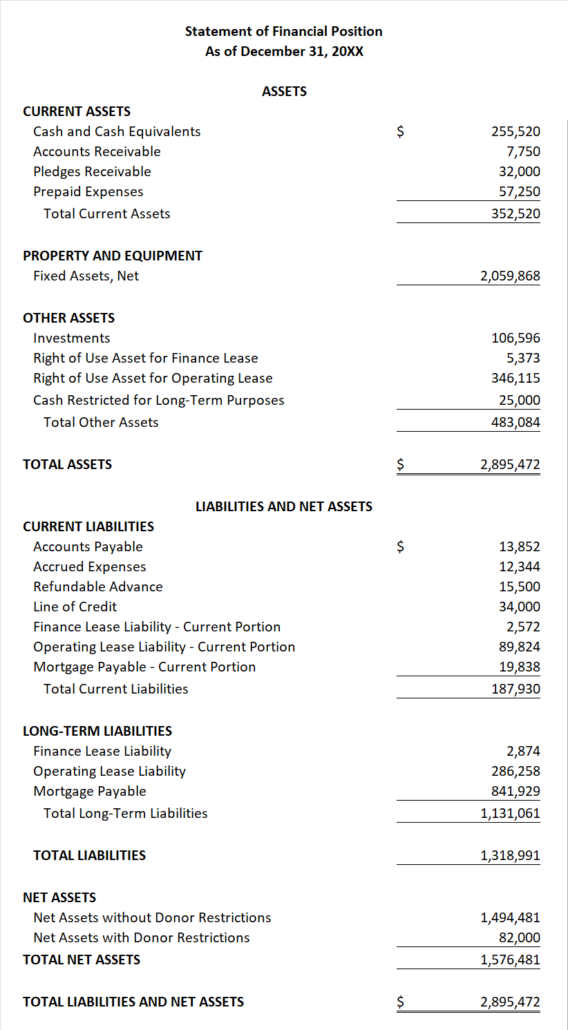
An example nonprofit balance sheet

Assets

Assets are resources your nonprofit owns or controls. You’ll categorize these assets based on their liquidity:

  • Current assets. Any item you can convert to cash quickly is a current asset. This category includes cash and cash equivalents, accounts receivable, pledges receivable, prepaid expenses, and inventory.
  • Noncurrent assets. Items your nonprofit intends to keep for at least a year, such as land, buildings, and equipment, are considered noncurrent assets.
  • Intangible assets. Some assets may not be physical but intellectual property like patents and copyrights. Nonprofits typically include these under noncurrent assets.

Liabilities

Liabilities are financial debts or obligations your nonprofit owes. You’ll categorize them similarly to assets:

  • Current liabilities. Short-term obligations you’ll pay within the next year are current liabilities. This category includes accounts payable, accrued expenses, and deferred revenue, which you’ll record when your nonprofit has received payment but has not yet delivered the associated goods or services.
  • Noncurrent liabilities. Long-term obligations you’ll pay in over a year are noncurrent liabilities. Common noncurrent liabilities include mortgages and long-term lease obligations.

Net Assets

Your net assets are the resources currently available to your organization. Calculate net assets by subtracting your liabilities from your assets. You’ll categorize them based on whether they have donor-imposed restrictions:

  • Net assets without donor restrictions. Let’s say your nonprofit hosts a 5K fundraiser and collects donations at the event. These general donations would fall under net assets without donor restrictions, allowing your team to use them for any purpose that fuels your mission.
  • Net assets with donor restrictions. On the other hand, you must use net assets with donor restrictions according to the associated limitations. Donors may designate funds for a particular purpose or set a time limit on fund use. Additionally, these restrictions may be permanent or temporary, potentially allowing you to use these funds for a different purpose later on.

How to Interpret a Nonprofit Balance Sheet

While your nonprofit ultimately wants to maximize its net assets, other outcomes—like low assets and high liabilities—should not always be cause for concern. To keep your team realistic and glean useful insights from your balance sheet, YPTC recommends following these tips:

  • Consider each section. Reviewing balance sheet categories in isolation doesn’t tell the full story about your nonprofit’s financial health. Instead, you must consider each section equally to understand the relationship between your assets and liabilities. For example, if you only focus on your assets, you may neglect debts in the liabilities section that even your seemingly strong pool of assets can’t cover. Alternatively, suppose you only focus on your liabilities. You may worry that they’re higher than usual when, in reality, your assets may have also increased to keep up with these greater debts.
  • Look into context. Even if you have low assets and high liabilities, the context behind these numbers matters. Potential scenarios that would cause lower net assets but not indicate a treacherous financial situation include major projects, seasonality, and high deferred revenue. For instance, you may develop a new program that requires a high initial investment but will ultimately power your mission in the long run. Alternatively, you might simply hit a slow giving period or generate a significant amount of deferred revenue that will eventually become assets.
  • Evaluate trends. Determine your nonprofit’s baseline to assess how your organization’s current financial health differs from past performance. For instance, you may have lower net assets than other similar organizations, but if your records indicate they’ve grown over the past few years, you’re likely on the path to sustainability.

Interpreting a balance sheet requires your team to think critically about your nonprofit’s unique situation and how it contributes to financial health. After all, your organization is meant to leverage the resources at its disposal to power its mission, so a perceived dip in resources may have a large payoff down the line.


In addition to helping your team understand your organization’s financial health and make well-informed decisions, balance sheets also function as stewardship tools. Share your balance sheet with donors to demonstrate responsible fund use and assure them that you’ll continue to leverage resources appropriately to keep your mission alive.